Upper vs Lower Antelope: Deciding Your Route
Located near Page, Arizona, on sacred Navajo Nation land, the canyon is split into two distinct, non-contiguous sections known traditionally as Tsé bighánílíní ("the place where water runs through rocks") and Hazdistazí ("spiral rock arches"):
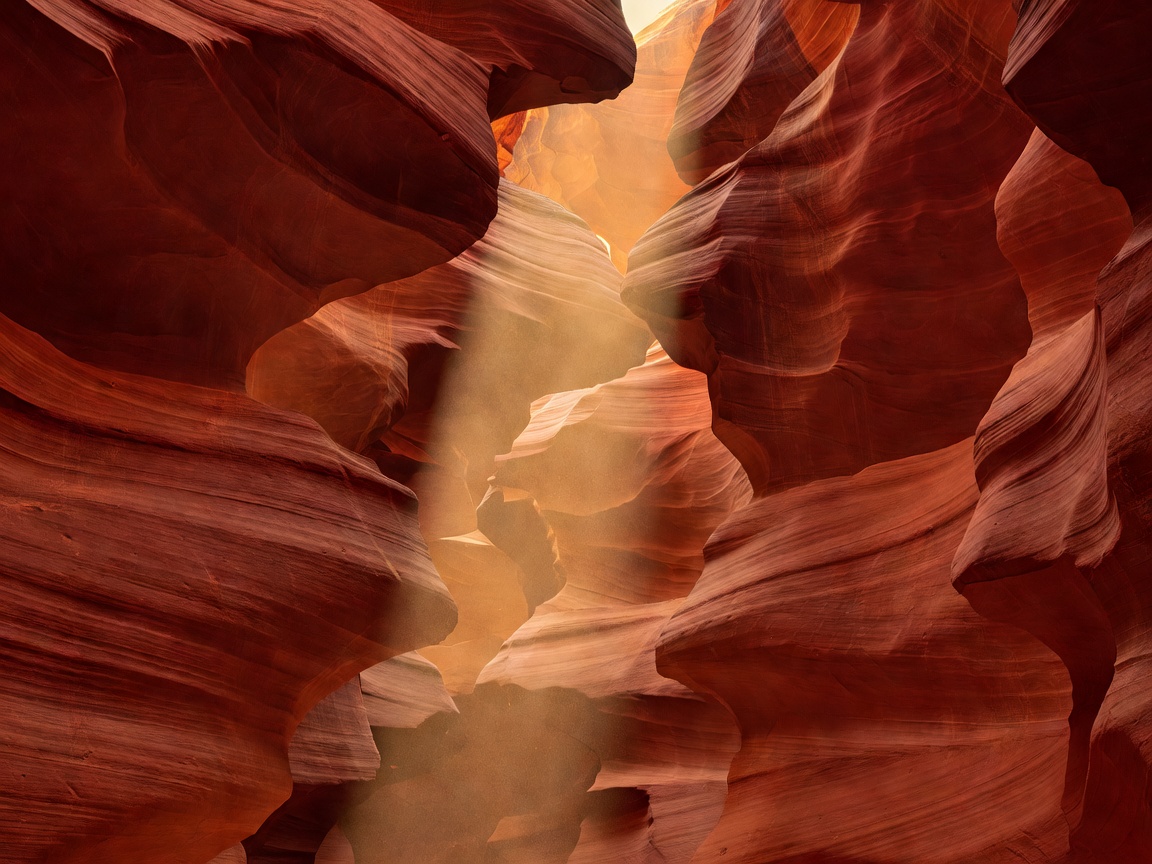
Upper Antelope Canyon (Tsé bighánílíní): Ground-level entrance and flat sandy path throughout. Famous for dramatic sun shafts shooting straight down like cathedral spotlights between late March and early October around solar noon (11:00 AM to 1:30 PM). More popular with families and photographers seeking beam phenomena.
Lower Antelope Canyon (Hazdistazí): Requires descending and climbing several steep, narrow metal staircases anchored directly into the rock. Longer, narrower, and more twisting than Upper Canyon, featuring dynamic wave patterns and cooler morning lighting conditions.
Flash Flood Geological Hazard Warning
Antelope Canyon was created entirely by catastrophic flash floods and remains an active drainage system. Rainstorms falling up to 30 miles away can channel millions of gallons of water into the slot without a single drop falling at the canyon itself. Strict automated radar monitoring and Navajo guide supervision have been standard protocol since the tragic 1997 flood.
Navajo Land Etiquette & Sacred Heritage
Antelope Canyon is not a United States National Park; it is a protected Navajo Tribal Park stewarded by Navajo Nation Parks & Recreation. To the Diné people, entering the canyon is akin to stepping into a spiritual sanctuary, demanding quiet reverence.
- Mandatory Escort: It is unlawful to visit either Upper or Lower Antelope Canyon without an authorized Navajo guide.
- Photography Equipment Restrictions: Tripods, monopods, selfie sticks, and drones are strictly prohibited on standard walking tours to preserve walkway safety and respect sacred ground.
- Leave No Sand or Scratch: Never deface sandstone surfaces or take sandstone fragments as souvenirs.
Camera & Light Beam Optimization
Because dynamic contrast between the dark interior canyon floor and the blinding blue sky overhead is immense, metering can challenge digital camera sensors:
- White Balance: Set your color temperature manually to "Cloudy" or "Shade" (approx 6,000K–7,000K) to bring out the richest crimson and amber hues naturally present in the iron-rich sandstone.
- Dust Protection: Never change camera lenses inside the slot. Fine airborne quartz particles kicked up by foot traffic can permanently scratch sensors and damage focal rings.
- Angle Strategy: Look straight upward; the canyon walls converge into swirling "wave" skylights that avoid sky blowout while highlighting stone textures.